English 11 · Reading R2 · Review draft
Fact or opinion, cause or effect
Test statements with the check question, and follow causes into their effects.
Suggested pace: 35–50 minutes, at your pace. This is an estimate, not a time limit.
The question
Your neighbour says: “The new market uphill is a disaster. Hardly anyone shops there in the mornings now.” One part of that sentence can be checked against records. The other part is what she thinks. Do you know which is which?
Every day you read and hear a mix of two kinds of statements. Some can be checked: dates, counts, events that happened. Others are judgments: what someone likes, fears or wishes. This lesson teaches two reading skills from the Grade 11 English curriculum: separating facts from opinions, and distinguishing causes from effects.
By the end, you should be able to test a statement with the question “can we check it?”; spot an opinion hiding inside a confident sentence; find the cause and the effect in a sentence, whichever comes first; and follow a chain of causes and effects without mistaking order for proof.
You need only basic English reading. Lesson R1 (skimming, scanning and topic sentences) helps but is not required. Write your answers on paper before opening any explanation panel.
Starting check
D1. “The bus leaves at 7 a.m.” Is that a fact or an opinion?
D2. “The bus is always too crowded.” Fact or opinion?
D3. In “The road flooded, so the bus was late”, which happened first in time, the flood or the lateness?
D4. True or false: if the cause is mentioned after the effect in a sentence, it is no longer the cause.
Check the starting questions
D1: a fact; you could check the timetable or stand at the stop at 7 a.m. D2: an opinion; “too crowded” is a judgment, and “always” only makes the judgment sound stronger. D3: the flood; the cause comes first in time, and “so” points from cause to effect. D4: false. Order in the sentence does not change order in time.
If D2 felt tricky, Idea 2 shows how opinions dress up as facts. If D4 surprised you, Idea 3 separates sentence order from time order. Keep reading: everything here starts from the beginning.
Idea 1: a fact can be checked, an opinion cannot
A fact is a statement you can check against something outside your own mind: a record, a measurement, or the event itself. “The market moved in 2021” is a fact because two careful people could look at the municipality’s decision and agree. An opinion is a judgment: what someone thinks or feels about something. “The market is too far” is an opinion, because two careful people can look at the same path and still disagree.
The check test is one question: could two careful people settle this by looking at a record, a measurement or the event itself? If yes, treat it as a fact. If they could still disagree after looking, it is an opinion. Opinion words are easy to spot once you look: best, worst, terrible, wonderful, too far, should, must, I think, I believe.
Idea 2: opinions can dress up as facts
A confident tone does not make a statement checkable. “Everyone knows the new market is too far” sounds like reporting, but apply the check test: even if everyone agreed, “too far” stays a judgment. It is an opinion in a confident costume.
There is also a two-layer case with quotes. When the text says that the ward chairperson called the move “the best decision this town has made in years”, that she said it is a fact you could check with her. What she said stays her opinion. Good readers keep the two layers separate.
The practice text
Read this original text once, at your normal speed. Then the worked examples will return to it again and again.
The Market That Moved Uphill
In 2021, the town of Basantapur moved its weekly vegetable market from the riverside to a new square near the bus park. The old site had flooded three times between 2018 and 2020, destroying crops worth about 1.2 million rupees in the worst year.
The move changed the town’s mornings. Because the new square is a twenty-minute walk uphill from the lower wards, many elderly shoppers stopped coming. As a result, several vendors lost their oldest customers. Some vendors then raised their prices, so a few buyers switched to a small shop near the temple.
Not everyone agrees about the change. “The new market is cleaner, safer and easier to reach by truck,” says ward chairperson Ramita Rai. “Moving it was the best decision this town has made in years.” Vendor Dhan Kumar Shrestha disagrees. “It is too far for the people who need it most,” he says. “The town should rebuild the old market by the river.”
The municipality has promised a small shuttle cart for elderly shoppers by next spring. Whether one cart can bring back the old crowd is a question only time can answer.
Idea 3: a cause makes its effect happen
A cause is what makes something happen; an effect is what happens because of it. The cause always comes earlier in time, but not always earlier in the sentence. English has both shapes: “Because the new square is uphill, many elderly shoppers stopped coming” names the cause first; “Several vendors lost their oldest customers as a result” names the effect first and points back to its cause.
Signal words help you. Because, since, due to introduce a cause. So, therefore, as a result, consequently, led to point towards an effect. When you meet one of these words, ask two questions: which event made the other happen, and which one happened earlier in time?
Idea 4: chains of causes, and the order trap
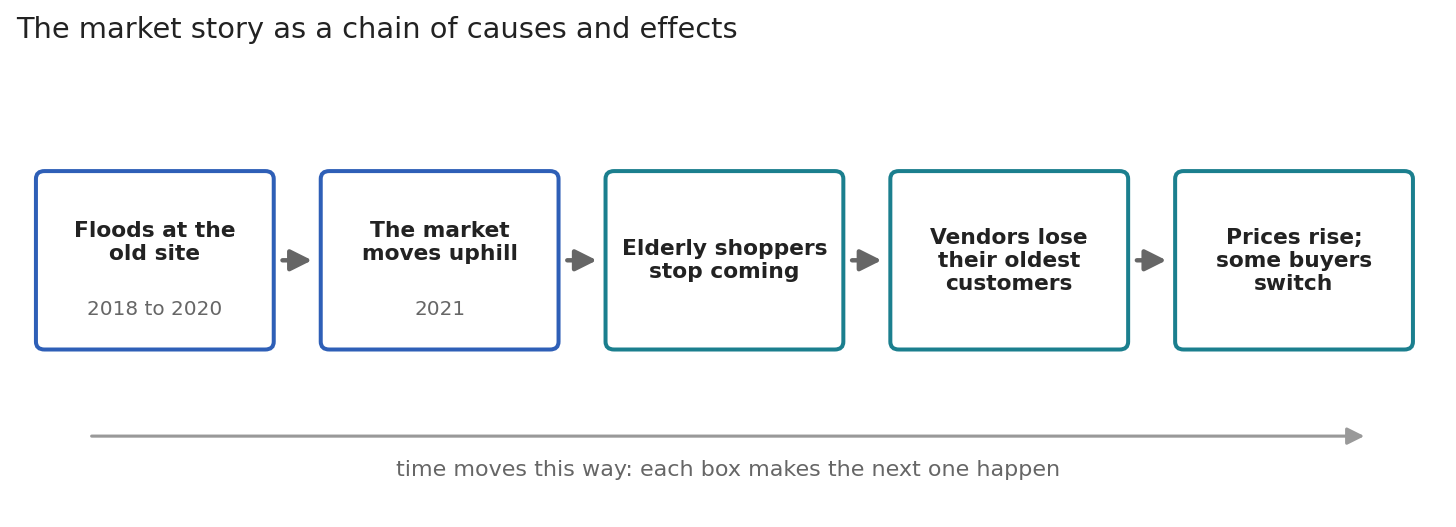
Causes and effects rarely come in single pairs. One event’s effect often becomes the next event’s cause, forming a chain: the market moved uphill, so many elderly shoppers stopped coming, so several vendors lost their oldest customers, so some raised their prices, so a few buyers switched shops. Each middle link is both an effect and a cause. When a question asks why something happened, the nearest link in the chain is usually the best answer.
Now the trap: happening after something is not the same as being caused by it. A rooster crows before the sunrise every day, but the crowing does not cause the sunrise. In the practice text, did the small temple shop open because the market moved? The text never says when it opened, so we cannot claim that. Order is a clue, not a proof; always ask whether the first event made the second happen.
Worked example 1: fact or opinion, using the check test
Sort these two statements from the practice text: (a) “The old site had flooded three times between 2018 and 2020.” (b) “Moving it was the best decision this town has made in years.”
Apply the check test: for (a), could two careful people settle it? Yes: municipal records or the memories of vendors would show whether floods happened three times in those years. It is a fact. For (b), could records settle it? No: two people can study the same records and still disagree about which decision was “best”. The word “best” is a judgment. It is an opinion, held by Ramita Rai.
Your turn A: is “The flood of 2020 destroyed crops worth about 1.2 million rupees” a fact or an opinion?
Check your attempt
Explanation: a fact. It reports a recorded estimate of the loss. The word “about” keeps the sentence honest: it marks the number as an estimate, and estimates of losses can be checked against records. A fact does not have to be exact; it has to be checkable.
Worked example 2: the dressed-up opinion
Vendor Dhan Kumar Shrestha says: “It is too far for the people who need it most.” This sounds like a measurement. Is it?
Look for the judgment word: “too far” claims more than “far”. The checkable fact inside the sentence would be the distance or the time: the text gives that elsewhere as a twenty-minute walk uphill from the lower wards. Whether twenty minutes is “too far” is Shrestha’s judgment, and shoppers with strong legs might disagree. So the statement is an opinion, and the fact that he said it is the only fact here.
Your turn B: find one opinion signal word in Ramita Rai’s quote and one in Shrestha’s.
Check your attempt
Explanation: Rai’s clearest signal is “best” (“the best decision”); “cleaner” and “safer” are judgments too, though closer to checkable. Shrestha gives “too far” and also “should” in “the town should rebuild the old market”, which is a judgment about what is right, not something a record can settle.
Worked example 3: cause and effect in one sentence
“Because the new square is a twenty-minute walk uphill from the lower wards, many elderly shoppers stopped coming.” Name the cause and the effect.
Follow the signal and the time: “because” introduces the cause: the twenty-minute uphill walk. The effect is what it produced: many elderly shoppers stopped coming. The walk also came first in time; the shoppers reacted to it. Rewritten with the other shape: “The new square is a twenty-minute walk uphill, so many elderly shoppers stopped coming.”
Worked example 4: the effect named first
The text says: “As a result, several vendors lost their oldest customers.” Where is the cause?
Let the signal point back: “as a result” points backwards, to the previous sentence: many elderly shoppers stopped coming. That is the cause; losing their oldest customers is the effect. The effect is named first in the text, but the cause still happened first in time. Sentence order is about style; time order is about causation.
Worked example 5: mapping the chain
Map the full chain of causes and effects in the second paragraph, then answer: why did some buyers switch to the temple shop?
Follow the signals: the move uphill caused elderly shoppers to stop coming (“because”); their absence caused vendors to lose their oldest customers (“as a result”); the lost customers led some vendors to raise their prices (“then”); the higher prices caused some buyers to switch (“so”). The chain is: move uphill → shoppers stop coming → vendors lose oldest customers → prices rise → buyers switch. The nearest cause of the switching is the raised prices; the market move is a cause further back in the same chain. Both are true, but “prices rose” is the tightest answer.
Your turn C: in “Some vendors then raised their prices, so a few buyers switched to a small shop near the temple”, name the cause, the effect and the signal word.
Check your attempt
Explanation: the cause is that some vendors raised their prices; the effect is that a few buyers switched to the temple shop; the signal word is “so”, pointing from cause to effect.
Interactive practice
Two small programs let you practise the mechanism itself. The sorter gives you statements from the lesson and asks you to judge fact or opinion, then shows the check-test reasoning. The chain explorer walks the market story one link at a time, so you can see each cause making its effect happen. Use them after your first reading of the ideas, and again before the exit check.
Interactive practice programs
Independent practice
Answer on paper from the practice text. Open each explanation only after your own attempt.
P1. “In 2021, the town of Basantapur moved its weekly vegetable market to a new square near the bus park.” Fact or opinion? How would you check it?
Check your attempt
Explanation: a fact. You could check the municipality’s decision records or the dates of the last riverside market and the first uphill market. No judgment words appear in it.
P2. “The new market is cleaner, safer and easier to reach by truck.” Fact or opinion? Whose is it?
Check your attempt
Explanation: an opinion, held by ward chairperson Ramita Rai. Judgments like “cleaner” and “safer” depend on what a person values, so two careful people could disagree. Only “easier to reach by truck” comes close to checkable, but the sentence as a whole is her judgment of the move.
P3. “The town should rebuild the old market by the river.” Fact or opinion? Which word gives it away?
Check your attempt
Explanation: an opinion; “should” signals a judgment about what is right to do, which no record can settle.
P4. In “Because the new square is a twenty-minute walk uphill from the lower wards, many elderly shoppers stopped coming”, which word signals the cause, and which event is it attached to?
Check your attempt
Explanation: “because” signals the cause, and it is attached to the twenty-minute uphill walk. The effect is that many elderly shoppers stopped coming.
P5. Rewrite this pair as one sentence without “as a result”, keeping the meaning: “Many elderly shoppers stopped coming. As a result, several vendors lost their oldest customers.”
Check your attempt
Explanation: one correct version: “Many elderly shoppers stopped coming, so several vendors lost their oldest customers.” Any version that keeps the shoppers’ absence as the cause and the lost customers as the effect is correct.
P6. In the chain from the market move to the price rise, what is the middle link?
Check your attempt
Explanation: several vendors lost their oldest customers. It is the effect of elderly shoppers stopping and the cause of some vendors raising prices.
P7. The last paragraph says: “Whether one cart can bring back the old crowd is a question only time can answer.” Does the text claim the shuttle cart will succeed?
Check your attempt
Explanation: no. It leaves the outcome undecided. A promise or a prediction about the future is not yet a fact; it becomes checkable only when the future arrives.
P8. Why is “crops worth about 1.2 million rupees” still a fact even though it says “about”?
Check your attempt
Explanation: it reports a recorded estimate, and estimates of a loss can be checked against records. “About” honestly marks the number as approximate; an approximate fact is still a fact, while a judgment like “a huge loss” would lean towards opinion.
P9. A classmate argues: “The temple shop appears in the story after the market moves, so the move caused the shop to exist.” What is wrong with this reasoning?
Check your attempt
Explanation: it confuses order with cause. The text never says when the shop opened or why, so the move cannot be named as its cause. Order is a clue, not a proof; remember the rooster and the sunrise.
P10. Give one fact and one opinion from the last two paragraphs of the practice text.
Check your attempt
Explanation: a fact: the municipality has promised a small shuttle cart for elderly shoppers by next spring (a promise on record is checkable). An opinion: “It is too far for the people who need it most”, or “Moving it was the best decision this town has made in years”.
P11. Remember your neighbour’s claim from the start of the lesson: “Hardly anyone shops there in the mornings now.” Before treating it as a fact, what would you ask?
Check your attempt
Explanation: ask what would count as “hardly anyone”, and compared with when. Numbers from the vendors or the municipality, such as morning sales before and after the move, would turn her impression into something checkable.
P12. In one or two sentences, explain the difference between a cause and an effect, using the market text.
Check your attempt
Explanation: a cause makes another event happen and comes earlier in time; an effect is what happens because of it. Example: the twenty-minute uphill walk (cause) made many elderly shoppers stop coming (effect), and their absence then became the cause of the vendors’ lost customers.
Check, return and extend
Exit check
E1. What single question tests whether a statement is a fact?
E2. What do words like “best”, “too far” and “should” usually signal?
E3. In “E because C”, which event happened first in time?
E4. Does “B happened after A” prove that A caused B?
Check the exit questions
E1: could two careful people settle it by looking at a record, a measurement or the event itself? E2: a judgment, so usually an opinion. E3: C, the cause, even though the sentence names it second. E4: no; order is a clue, not a proof. Ask whether A made B happen.
For this lesson, move on when you can sort statements into fact and opinion using the check test, find the cause and the effect in either sentence order, and map a short cause-effect chain from a text. This is a suggested learning rule, not an official pass mark.
Return review
Tomorrow: without rereading, write one fact and one opinion from the market text. Example answers: the old site flooded three times between 2018 and 2020 (fact); the move was the best decision in years (Rai’s opinion).
In about one week: take a short news report. Underline two facts, circle two opinions, and draw one cause-effect chain as boxes and arrows, the way the diagram in this lesson does.
Extend beyond the lesson
The next reading lessons build directly on these skills: comparing and contrasting ideas, identifying the order of events, and finding explicit and implicit information. Facts-versus-opinions and cause-effect chains also return in every other subject: science explanations argue from causes, and history essays are judged on how well they separate evidence from interpretation.
Sources and limits
The explanations, the practice text, the diagram, the interactive programs and the questions are original. No textbook passage, literary work or examination paper is reproduced. The skills taught follow the Grade 11 reading outcomes of the official Secondary Education (Grade 11 & 12) Curriculum, 2077 (English, section 3.3): separating facts from opinions and distinguishing between cause and effect. The prescribed reading texts themselves live in the official textbook, which this lesson does not replace.
This is not an official paper, teacher-endorsed course or complete unit. Comparing and contrasting ideas, inference and literature reading need their own lessons. Spaced review is informed by the IES learning practice guide; the suggested timing is not an optimal schedule proven for every learner. This material has not been reviewed by a qualified NEB teacher.
Revision ENG11-R2 · Consistency checked · 20 November 2026.