Foundation F01 · Review draft
A number needs a unit
The number can change while the size stays the same.
Suggested pace: 35–50 minutes, at your pace. This is an estimate, not a time limit.
The question
Two students measure the same tabletop. Asha writes “120”. Milan writes “1.2”. Can both be correct?
Yes, if Asha means 120 centimetres and Milan means 1.2 metres. The numbers look different because the unit-sized piece is different. The table has not changed. A measurement needs a number and a unit so that another person can understand the size being described.
By the end, you should be able to explain a quantity, number and unit; convert lengths and times using equal ratios; handle a simple speed; explain why an area conversion uses a squared factor; and check whether an answer is plausible.
You need multiplication and division of whole numbers and simple decimals. You do not need algebra, powers of ten or a memorised physics formula to start. Work on paper. Attempt each question before opening its solution.
Starting check
D1. What is missing from “the journey took 30”?
D2. If one packet has 4 pencils, how many pencils are in 3 packets?
D3. Which describes the longer length: 1 m or 100 cm?
D4. What does “12 metres in 3 seconds” tell you about the distance covered per second, if the rate is constant?
Check the starting questions
D1: the unit of time is missing. Thirty seconds and thirty minutes are different durations. D2: pencils. D3: neither is longer; the lengths are equal. D4: divide the total distance into three equal one-second shares, metres each second.
If D2 or D4 was difficult, draw three boxes and share the total equally before using a formula. If D3 was difficult, keep reading: conversion is the central idea of this lesson, not a test you should already have passed.
Idea 1: quantity, numerical value and unit
A quantity is a property whose magnitude we can express. In this lesson, examples include length, time and mass. A unit is the agreed reference size used to describe that magnitude. The numerical value tells us how many of those unit-sized pieces there are.
In “the ribbon is 75 cm long”, the quantity is length, the numerical value is 75 and the unit is the centimetre. The symbol cm is not an optional label added at the end. It helps define what the number means.
Changing units changes the numerical value but preserves the quantity. Smaller unit-sized pieces require more pieces to span the same object. That is why a length has a larger numerical value in centimetres than in metres.
The SI base unit of length is the metre, symbol m. The base unit of time is the second, s. The base unit of mass is the kilogram, kg. Units such as centimetres and minutes remain useful, but they must be converted consistently when a calculation requires it.
Notation: write 5 m, with a space between the number and symbol. Unit symbols do not gain a plural s: 5 kg, not 5 kgs. In this lesson, “/” means division, so m/s means metres divided by seconds.
Idea 2: an equal ratio changes the description, not the size
We will use these exact conversion relationships:
Because 1 m and 100 cm are equal lengths, their ratio is one. Multiplying a quantity by this ratio does not change the quantity. Choose its orientation so that the unit you no longer want cancels.
Worked example 1: 360 cm to metres
We want cm to disappear and m to remain. Put cm in the bottom of the conversion factor:
The cm in the numerator and denominator cancel. The arithmetic is . We used a larger unit, so the number became smaller. That is a useful reasonableness check.
Your turn A: convert 450 cm to metres. Hint: use the same conversion factor, but do not copy 3.6.
Check your attempt
Explanation: , so the length is 4.5 m. Both 450 cm and 4.5 m describe the same length.
Worked example 2: a journey lasting 2 min 30 s
A mixed time must be expressed in one unit before adding. Convert just the two-minute part:
Now both terms have seconds, so . Do not write 2.30 min: thirty seconds is half a minute, not 0.30 of a minute. In minutes, the duration is 2.5 min.
Your turn B: convert 1 min 45 s to seconds.
Check your attempt
Explanation: one minute contributes 60 s. Adding 45 s gives 105 s. The answer must be more than 60 s and less than 120 s, which 105 s is.
Idea 3: a rate compares two quantities
A walking rate of 1.5 m/s means 1.5 metres of distance for each second, if the rate stays constant. An average speed uses the total distance divided by the total elapsed time:
An average does not tell us that the person moved at that speed every moment. They may have slowed, stopped or sped up. We use this distinction so that a correct calculation does not become an incorrect story.
Worked example 3: a school walk
A learner walks 180 m in 2 min. First express the time in seconds: s. Then divide:
The answer means the total distance divided by the total duration is 1.5 m per second. It does not prove a constant walking speed. Dividing 180 by 2 would give 90 m/min, which is also correct, but it is not 90 m/s.
Your turn C: a learner walks 240 m in 3 min. Find the average speed in m/s.
Check your attempt
Explanation: the duration is 180 s. m/s, approximately 1.33 m/s. The fraction is exact for the stated numbers; the decimal is a rounded display. Measurement precision is a later topic.
Worked example 4: converting 54 km/h to m/s
The starting speed already contains a division. We must change both the distance unit and the time unit:
The km cancels with km, and h cancels with h. Numerically, . The hour conversion is inverted because h starts in the denominator of the speed. Looking at the units is safer than remembering “multiply or divide by 3.6” without knowing why.
Your turn D: convert 36 km/h to m/s.
Check your attempt
Explanation: m/s. Converting back gives km/h, so the two-way check works.
Idea 4: an area is not a length
A square one metre wide and one metre tall has area one square metre. Each side is 100 cm, so the same area is square centimetres.
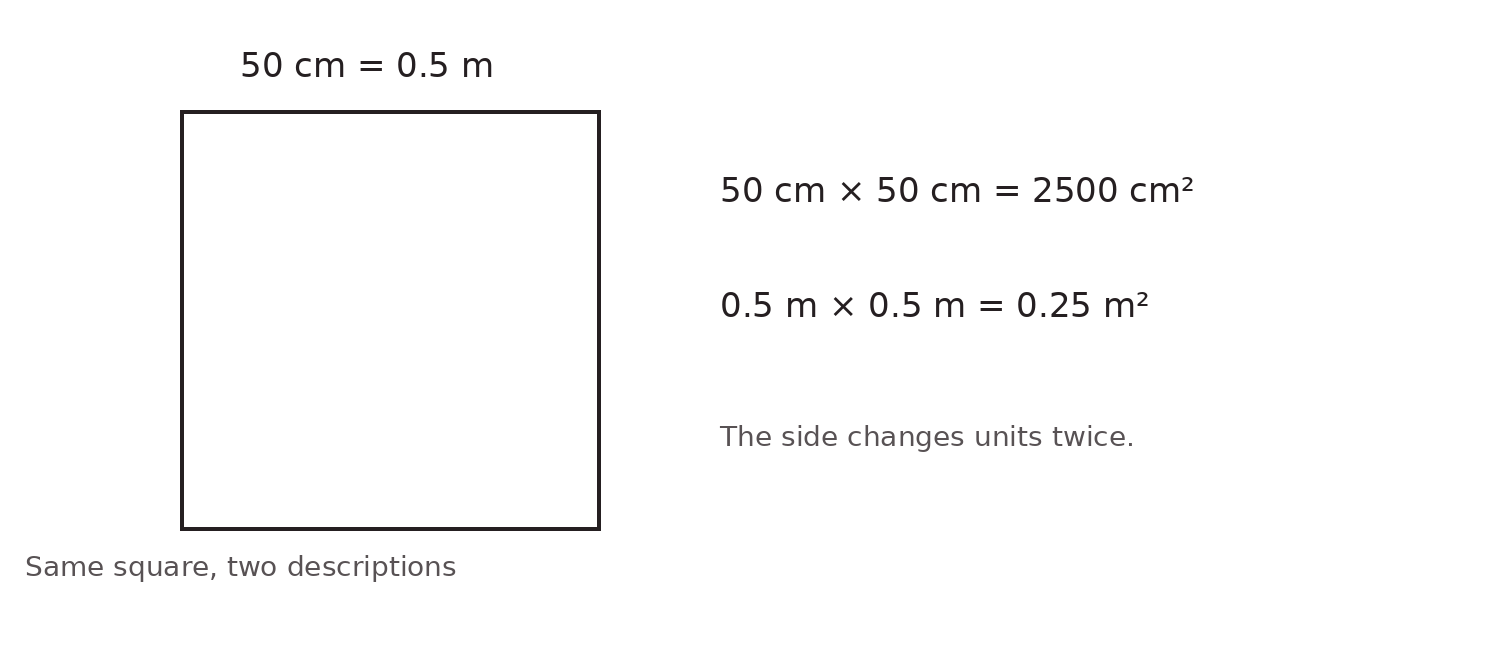
The small 2 means “squared”: the length factor occurs twice. It does not mean “multiply the final answer by two”. Check both side lengths before multiplying. The square in the diagram uses smaller sides to show the same two-factor idea.
Worked example 5: 2500 cm² to m²
Apply the conversion factor twice:
Dividing by 100 would incorrectly treat area as length. A second check is a 50 cm by 50 cm square: it is 0.5 m by 0.5 m, whose area is 0.25 m².
Your turn E: convert 0.08 m² to cm².
Check your attempt
Explanation: cm². The numerical value grows because each square centimetre is smaller than a square metre.
Independent practice
Try each question before opening its explanation. These are original learning questions, not claimed NEB past-paper questions. Do not time the first attempt. Write the conversion factor and units, not only a final number.
Build confidence
P1. In “a bag has mass 3.2 kg”, identify the quantity, numerical value and unit.
Show explanation for P1
P1. The property is mass. Its numerical value is 3.2 and its unit is kg. Mass and weight are not interchangeable words in a physics explanation; weight is a force, taught later.
P2. Convert 725 cm to m.
Show explanation for P2
P2. m. Centimetres cancel. Since a metre is larger, fewer metres describe the same length.
P3. Convert 0.48 km to m.
Show explanation for P3
P3. m. We multiply by 1000 because each kilometre contains 1000 metres. The answer is less than 1000 m because the starting length is less than 1 km.
P4. Convert 4 min 15 s to s.
Show explanation for P4
P4. The four-minute part is s. Add the remaining 15 s to obtain 255 s. Multiplying 4.15 by 60 would answer a different question, because 4 min 15 s is not 4.15 min.
Apply and explain
P5. A learner covers 360 m in 4 min. Find the average speed in m/s. Does the result prove they never stopped?
Show explanation for P5
P5. Four minutes is 240 s. Average speed is m/s. This only describes total distance divided by total duration. A stop is compatible with the average if the moving portions are fast enough.
P6. Convert 72 km/h to m/s. Then convert your answer back.
Show explanation for P6
P6. m/s. The reverse calculation is km/h. Using the inverse conversion to check catches many flipped factors.
P7. A board is 80 cm long and 50 cm wide. Find its area in m² using two methods.
Show explanation for P7
P7. Method one: convert both sides first. They are 0.8 m and 0.5 m, so area is m². Method two: calculate cm², then divide by 10 000 to get 0.4 m². The agreement checks that the factor has been applied twice.
P8. Convert 0.035 m² to cm². Explain why the numerical value becomes larger.
Show explanation for P8
P8. cm². The same area contains many more small square-centimetre pieces than square-metre pieces. A larger number is expected here; it does not mean the area grew.
Think more deeply
P9. A solution says . Identify the mistake and repair it using a conversion factor.
Show explanation for P9
P9. The conversion has been reversed and the units do not justify the operation. Use m. If someone instead uses , the starting cm will not cancel into the desired final unit.
P10. Two walks have equal distance: 120 m in 60 s, then 120 m in 120 s. Find the average speed over the whole journey. Is it the ordinary arithmetic mean of the two speeds?
Show explanation for P10
P10. Total distance is m. Total time is s. Whole-journey average is m/s, approximately 1.33 m/s. The segment speeds are 2 m/s and 1 m/s; their arithmetic mean is 1.5 m/s, which is not the whole-journey answer. More time was spent at the slower speed. Always return to the definition using total distance and total time.
P11. Is the statement “a larger numerical value always means a larger quantity” true? Give a counterexample with length.
Show explanation for P11
P11. False when units differ. For example, 80 cm has the larger numerical value but is shorter than 2 m, because 2 m is 200 cm. Compare quantities only after expressing them in compatible units.
P12. Design a rectangular mat with area 0.6 m². Give one possible pair of side lengths in metres and in centimetres, and check the area in both unit systems.
Show explanation for P12
P12. One valid answer is 1.2 m by 0.5 m. Its area is m². In centimetres the sides are 120 cm and 50 cm; their product is 6000 cm². Dividing by 10 000 returns 0.6 m². Many rectangles work; an answer is valid if its positive side lengths have the required product and both conversions agree.
If an answer went wrong
| Pattern | Repair |
|---|---|
| You know an answer but cannot explain it | Say what each unit means, then write the equal conversion ratio. |
| You multiply when you should divide | Put the units in the expression and arrange cancellation before calculating. |
| You write 2 min 30 s as 2.30 min | Convert each part separately before adding. |
| Your area answer is off by a factor of 100 | Convert both side lengths or square the length conversion factor. |
| You average speeds without using total time | Add distances and durations first, then divide once. |
Check, return and extend
Exit check
Close the worked examples. Explain your reasoning in a sentence for each answer.
E1. Convert 0.65 km to m.
E2. Convert 90 s to min.
E3. A rectangle is 20 cm by 30 cm. Find its area in m².
E4. Why is a unit conversion not a change in the size of an object?
Check the exit questions
Explanations: E1 is 650 m because each km contains 1000 m. E2 is 1.5 min because . E3 is m², or m². E4: the same magnitude is being counted using a different reference unit.
For this lesson, move on when you can explain the unit choice and complete the length, time and area checks without copying. This is a suggested learning rule, not an official pass mark. If you need help, return to the matching worked example and solve a changed-number version before retrying.
Return review
Tomorrow: without rereading, convert 275 cm to m and explain why the number shrinks. Answer: 2.75 m, because a metre-sized piece is larger than a centimetre-sized piece.
In about one week: convert 18 km/h to m/s. Answer: m/s. Write the cancellation, not just the shortcut.
In a later motion lesson: a journey covers 150 m in 50 s and 150 m in 100 s. Find the overall average speed. Answer: total distance is 300 m and total time is 150 s, so 2 m/s. The segment speeds are 3 m/s and 1.5 m/s; their unweighted mean is not the correct journey average.
The timing can be adjusted to the learner and timetable. The point is to retrieve the idea after a delay and connect it with later work, not to earn a streak.
Optional safe activity
Use an ordinary ruler to measure two sides of a notebook. Record the readings in centimetres, convert both to metres and calculate the approximate cover area in both systems. Do not invent a “correct” result in advance: notebooks have different sizes, and ruler readings have limitations. Compare the two calculated areas after conversion. The arithmetic should agree even though the measurements are approximate.
No mains electricity, heat, chemicals or outdoor travel is needed. If a ruler is unavailable, use the stated dimensions in P7 rather than guessing a measurement.
Next lessons
A complete foundation unit should continue with powers of ten and prefixes, significant figures and rounding, measurement uncertainty, and dimensions with the limits of dimensional analysis. These are proposed next lessons, not already delivered material. The course then needs vectors, graphs and algebra bridges where its verified outcome map requires them.
Sources and limits
The explanations, examples, diagram and questions are original. Unit conventions were checked against BIPM's SI Brochure and its base-unit reference. The physical-quantities starting point was compared with the CDC Physics Grade 11 feedback-copy listing. It does not establish current-cohort adoption.
This is not an official paper, teacher-endorsed course or complete chapter. Significant figures, uncertainty and dimensional analysis need separate lessons. Spaced review is informed by the IES learning practice guide; the suggested timing is not an optimal schedule proven for every learner.
Revision F01-R1 · Source check 19 November 2026.