Foundation F02 · Review draft
Fair shares
Fractions, ratios and percentages: three notations that connect, with care at the seams.
Suggested pace: 40–55 minutes, at your pace. This is an estimate, not a time limit.
The question
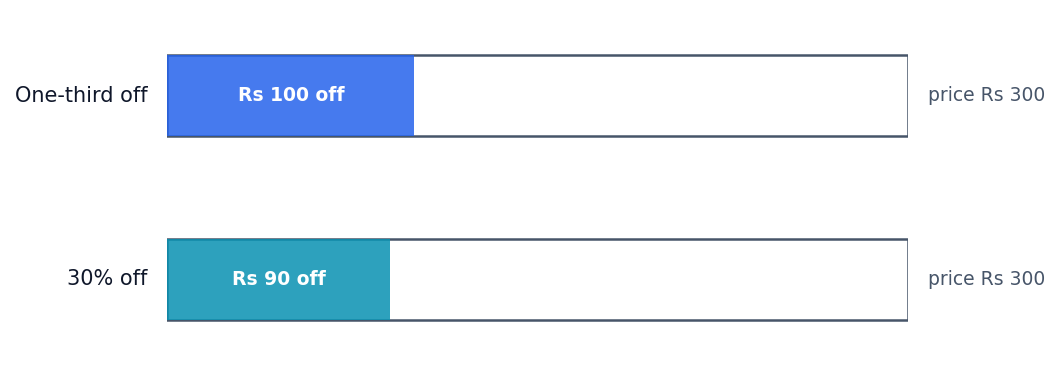
Two shops sell the same school bag for the same price. Shop A offers “one-third off”. Shop B offers “30% off”. Which shop saves you more money?
One saving is written as a fraction and the other as a percentage, so they cannot be compared as they stand. Written in the same form, one-third is about 33.3%, which is more than 30%. Shop A gives the larger discount. Comparing shares becomes easy once every share is written in the same language. Along the way we will also see where the three notations do not overlap: a ratio such as 3:2 is not automatically a fraction of a whole.
By the end, you should be able to explain a fraction as equal parts of a whole; simplify fractions and ratios; move between fractions, decimals and percentages; find a percentage of a quantity; calculate a discount or increase; and undo a percentage change to find the original amount.
You need multiplication and division of whole numbers and simple decimals. Foundation lesson F01 (units and conversions) is helpful but not required. Work on paper and attempt each question before opening its solution.
Starting check
D1. A roti is cut into 4 equal pieces and you eat 1 piece. What fraction of the roti did you eat?
D2. What is half of 90?
D3. What is 50% of Rs 800?
D4. In a class of 20 students, 5 are absent. What fraction of the class is absent, in its simplest form?
Check the starting questions
D1: one piece out of four equal pieces is . D2: . D3: 50% means fifty out of every hundred, which is half, so 50% of Rs 800 is Rs 400. D4: the fraction is , and dividing top and bottom by 5 gives .
If D3 felt uncertain, that is exactly Idea 3. If D4 was difficult, Idea 2 shows how simplifying works. Keep reading: this lesson starts from the beginning and assumes none of it.
Idea 1: a fraction counts equal parts
A fraction describes equal parts of a whole. In , the bottom number (the denominator) says the whole is divided into 8 equal parts, and the top number (the numerator) says we are counting 3 of those parts.
The fraction bar also means division: . Being able to switch between “three parts out of eight”, the division 3 ÷ 8 and the decimal 0.375 is what makes fractions useful in calculations.
Finding a fraction of a quantity means multiplying. One eighth of 400 m is m, so three eighths is m. Dividing by the denominator first keeps the numbers small and the meaning clear: split into equal parts, then count the parts you want.
Worked example 1: three-eighths of a trail
A walking trail is 400 m long. How far is of the trail?
Check by the two-step meaning: one eighth is m, and three such parts are m. Both routes agree, and 150 m is less than half of 400 m, which fits .
Your turn A: find of 250 g.
Check your attempt
Explanation: one fifth is g, so two fifths is g. Multiplying in one step gives the same result: g.
Idea 2: equivalent fractions and ratios
Different fractions can name the same share. and are equivalent because multiplying top and bottom by the same number does not change the share: the parts get smaller, but you count more of them.
Simplifying runs this backwards: divide top and bottom by a common factor until none is left. A fraction in simplest form is the clearest name for the share.
A ratio such as 3:2 compares two quantities directly: 3 parts of one to 2 parts of the other. Ratios simplify exactly like fractions. Converting between a ratio and a fraction needs one careful step: in a 3:2 mixture there are 5 equal parts in total, so the first ingredient is of the whole. That fraction exists only because the ratio compares parts of one whole. A ratio can also compare separate quantities, such as 3 wins to 2 losses; then there is no whole until you choose one, and 3:2 by itself is not of anything.
Worked example 2: simplify a fraction, then a mixture
Simplify . Both numbers divide by 8:
Now a cook mixes 300 g of flour with 200 g of sugar. The ratio is 300:200, and dividing both sides by 100 gives 3:2. The whole mixture has g, so flour is of it: the same share, seen from the part-to-whole side.
Your turn B: simplify , then write the ratio 350 mL : 150 mL in simplest form.
Check your attempt
Explanation: dividing 45 and 60 by 15 gives . For the volumes, dividing 350 and 150 by 50 gives the ratio 7:3. Any common factor works as a first step; if the result can still be simplified, simplify again.
Idea 3: a percentage is a fraction out of one hundred
The symbol % means “out of one hundred”. means , which is the decimal 0.45. Percentages are not a new kind of number; they are fractions with denominator 100, which is why any two shares are easy to compare once both are written as percentages.
The three conversions used constantly:
Worked example 3: writing a share as a percentage
Ashim answered 17 of 25 questions correctly. What percentage is that?
A quick alternative when the denominator divides 100: make the denominator 100 directly, , and read off 68%. Both methods must agree, because both come from the definition.
Your turn C: write as a percentage.
Check your attempt
Explanation: , so the share is 35%. Equivalently, multiplying top and bottom by 5 gives .
Idea 4: percentages of quantities, and undoing a change
Finding a percentage of a quantity is the same multiplication as Idea 1, with the share written per hundred:
A percentage change has one extra idea: the percentage always refers to the starting amount, called the base. A 25% discount removes 25% of the original price; you pay the remaining 75%. A 10% raise adds 10% of the original salary; you receive 110% of it.
Undoing a change means working backwards from the new amount. If 75% of the original price is Rs 900, then 1% is rupees and 100% is rupees. Dividing by the percentage that remains (in decimal form, ) is the same idea in one step. The common error is taking 25% of 900 and adding it back; that uses the wrong base.
Worked example 4: a discount on a bag
A bag is priced at Rs 2,400 with 25% off. Find the discount and the price paid.
Faster and safer: paying 75% of the price in one step, rupees, and the discount is what is left out. The two routes must agree.
Your turn D: find 15% of Rs 640.
Check your attempt
Explanation: rupees. A build-up check: 10% is 64 and 5% is 32, and .
Worked example 5: undoing a discount
After a 20% discount, a jacket costs Rs 1,600. What was the original price?
The price paid is 80% of the original. So one percent of the original is rupees, and the whole original is:
Check forwards: 20% of 2,000 is , and . The round trip confirms the base was right. Taking 20% of 1,600 (320) and adding it would give 1,920, which is wrong because the discount was measured on the original, not on the sale price.
Your turn E: after a 10% increase, a monthly rent is Rs 5,500. Find the original rent.
Check your attempt
Explanation: the new rent is 110% of the original, so the original is rupees. Check: 10% of 5,000 is 500, and .
Interactive practice
The percentage explorer applies or undoes a percentage change on an amount you choose. Move the percentage and watch the hundred-grid and the calculation move together. Try to predict each result before it appears.
Independent practice
Try each question before opening its explanation. These are original learning questions, not claimed NEB past-paper questions. Write the share and the base in words before computing; most percentage mistakes are base mistakes.
Build confidence
P1. In the statement “ of the class walks to school”, what do the numbers 10 and 7 each describe?
Show explanation for P1
P1. The 10 says the class is thought of as 10 equal parts; the 7 counts how many of those parts walk. The fraction is a part-to-whole statement; the whole is the class.
P2. Write as a decimal.
Show explanation for P2
P2. The bar means division: . A staged way to see it: one eighth of 1 is 0.125, and five eighths is .
P3. Write 0.35 as a percentage.
Show explanation for P3
P3. , so 0.35 is 35%. Multiplying by 100 moves the point two places, because a percentage counts hundredths.
P4. Write 12% as a fraction in simplest form.
Show explanation for P4
P4. , and dividing top and bottom by 4 gives . The intermediate form is correct but not simplest.
Apply and explain
P5. Which is the larger share, or 62%? Show the comparison in one common form.
Show explanation for P5
P5. , and 62.5% is larger than 62%. Comparing the raw numbers 5, 8 and 62 says nothing; shares are only comparable in a common form.
P6. Find 30% of Rs 950.
Show explanation for P6
P6. rupees. Check by building: 10% is 95, so 30% is .
P7. A volleyball team won 12 of its 20 matches. What percentage did it win, and what percentage did it not win?
Show explanation for P7
P7. Won: , so 60%. Not won: the remaining 8 matches, , so 40%. The two percentages must add to 100% because they share the same base of 20 matches; confirms it.
P8. A shirt priced at Rs 2,400 is sold at 25% off. Find the discount and the price paid, using two different routes.
Show explanation for P8
P8. Route one: discount rupees, price paid rupees. Route two: pay 75% directly, rupees, with the discount as the difference. Agreement between routes is the check.
Think more deeply
P9. A friend’s working says: “10% of 480 is 48, so 20% is 96, so 30% of 480 is .” Is the method valid? Explain why or why not, and verify the final answer another way.
Show explanation for P9
P9. The method is valid: percentages of the same base add, because 30% of a quantity is 10% of it plus 20% of it. Verify directly: . The method works only while every percentage refers to the same base of 480.
P10. After a 15% increase, a salary is Rs 57,500. Find the original salary, and check your answer forwards.
Show explanation for P10
P10. The new salary is 115% of the original, so the original is rupees. Forwards check: 15% of 50,000 is , and . Taking 15% of 57,500 and subtracting would use the new salary as the base, which the increase did not.
P11. True or false: “If a price rises by 10% and then falls by 10%, it returns to its original value.” Decide using the starting price 200, and explain where the argument breaks.
Show explanation for P11
P11. False. After the rise the price is . The fall is 10% of 220, which is 22, leaving . The two 10% changes have different bases: the increase is measured on 200 and the decrease on 220. Equal percentages with different bases are different amounts.
P12. Two savings offers apply to a deposit of Rs 5,000. Offer A adds one-fifth extra; offer B adds 18% extra. Compute each gain, state which is larger and by how much, and explain the comparison step.
Show explanation for P12
P12. Offer A adds rupees. Offer B adds rupees. Offer A is larger by rupees. The comparison is fair because both shares were applied to the same base of 5,000; in fraction form, .
If an answer went wrong
| Pattern | Repair |
|---|---|
| You are not sure which quantity is the whole | Ask “the share of what?” and name the base before computing. |
| You wrote 0.5 as 5% | Decimals convert by multiplying by 100: 0.5 is 50%. |
| You added percentages with different bases | Convert each percentage to an amount first, then combine amounts. |
| To undo a discount, you took the percentage of the new price | Divide the new price by the percentage that remains, then check forwards. |
| Your fraction answer is correct but not simplified | Divide top and bottom by a common factor; repeat until none is left. |
Check, return and extend
Exit check
Close the worked examples. Explain your reasoning in a sentence for each answer.
E1. Write as a percentage.
Show explanation for E1
E1. , so 68%. Scaling to a denominator of 100 gives directly.
E2. Find 35% of 240.
Show explanation for E2
E2. . Building up: 10% is 24, 30% is 72 and 5% is 12, so 35% is .
E3. A bottle costs Rs 750 after a 25% discount. What was the original price?
Show explanation for E3
E3. The price paid is 75% of the original, so the original is rupees. Check: 25% of 1,000 is 250, and .
E4. Which is larger, or 65%?
Show explanation for E4
E4. , which is larger than 65%. The repeating decimal is fine for a comparison; an exact fraction comparison is against .
Return review
After two or three days, redo P2, P6 and P10 without looking at the explanations. After about a week, redo E3 and P11. The delay is deliberate: retrieving the idea from memory, not re-reading it, is what makes it stay.
One safe activity
Find one real price tag at home or in a shop, imagine a 15% discount, and compute the new price two ways: find 15% and subtract, and multiply by 0.85 directly. Then undo it: pretend the discounted price is all you know and recover the tag price by dividing by 0.85. Write the two routes and their agreement on paper. No purchase, account or device is needed.
Sources and limits
The explanations, examples, diagram and questions are original. The mathematics is elementary and standard: fractions as equal parts, percentages as hundredths and base-aware percentage change. No textbook passage, illustration or question bank is reproduced.
This is not an official paper, teacher-endorsed course or complete chapter. Applications such as interest, profit and loss, and data tables need their own lessons. Spaced review is informed by the IES learning practice guide; the suggested timing is not an optimal schedule proven for every learner.
Revision F02-R1 · Arithmetic checked exactly · 19 November 2026.