Foundation F04 · Review draft
Powers of ten and prefixes
Read very large and very small numbers with powers of ten and the unit prefixes.
Suggested pace: 40–55 minutes, at your pace. This is an estimate, not a time limit.
The question
Sita’s phone plan gives her 25 gigabytes of data each month, and one photo takes about 4 megabytes. Her little brother’s syrup bottle says 250 milligrams in every 5 millilitres. The heater in the living room says 2 kilowatts. Gigabytes, milligrams, kilowatts: the words are everywhere, but what do the parts giga, milli and kilo actually do to a number?
Each of those parts is a prefix: a short name glued to the front of a unit that multiplies it by a power of ten. Kilo means a thousand, so a kilometre is a thousand metres. Milli means a thousandth, so a milligram is a thousandth of a gram. Learn about ten prefixes and you can read storage sizes, medicine doses, electricity ratings, map distances and laboratory measurements with the same skill.
Behind every prefix stands one idea: the power of ten. This lesson builds that idea first, then shows how prefixes are simply names for powers of ten, and finishes with scientific notation, the standard way scientists write very large and very small numbers. By the end you should be able to read and write powers of ten, multiply and divide by them, convert between prefixed units step by step, and write a quantity in scientific notation.
You need multiplication and division with decimals. Work on paper, and attempt each question before opening its solution.
Starting check
Answer these from what you already know. Open the panel only after trying all four.
D1. What is 10 × 10 × 10?
D2. How many grams are in one kilogram?
D3. Which is longer, 1 centimetre or 1 millimetre? By how many times?
D4. What is 3 × 1,000?
Check your answers
Explanation: D1: 1,000. D2: 1,000 grams; kilo means a thousand. D3: 1 centimetre is longer; 1 cm = 10 mm, so it is ten times a millimetre. D4: 3,000. If D2 and D3 felt familiar, you already know two prefixes by heart; this lesson turns that familiarity into a system.
Idea 1: a power of ten counts the tens
Multiply ten by itself and the answer grows by one zero each time: 10, then 100, then 1,000, then 10,000. Writing long chains of tens is clumsy, so mathematics counts them instead. The power of ten written 104 means four tens multiplied together: 10 × 10 × 10 × 10 = 10,000. The small raised number is the exponent, and it counts the tens. It also counts the zeros: 104 is a 1 followed by four zeros.
Two special cases complete the pattern. 101 is just 10. And 100 is 1: zero tens multiplied together leaves the starting number, one. Watch the pattern divide by ten each step down: 1,000, 100, 10, 1.
Keep dividing by ten and the pattern continues below one: 10−1 = 0.1 (one tenth), 10−2 = 0.01 (one hundredth), 10−3 = 0.001 (one thousandth). A negative exponent counts the decimal places instead of the zeros. Powers of ten therefore reach in both directions: as large as you like, and as small as you like, always by steps of ten.
Idea 2: multiplying by a power of ten moves the digits
Multiply 3.65 by 10 and the answer is 36.5: the decimal point moved one place to the right. Multiply by 102 = 100 and it moves two places: 365. Multiply by 103 = 1,000 and it moves three places: 3,650. The exponent tells you how many places the digits slide, and multiplying slides them right, towards bigger numbers.
Dividing slides the digits the other way. 47 ÷ 10 = 4.7, and 47 ÷ 102 = 0.47: the point moved two places left, and we filled the gap with a zero. The same movement works for negative exponents, because multiplying by 10−2 is the same as dividing by 102: 5 × 10−2 = 0.05.
This one rule, the exponent counts the places the point moves, does almost all the work in this lesson. Prefixes and scientific notation are both built on it.
Idea 3: a prefix is a name for a power of ten
The measurement system gives the most useful powers of ten short names, the prefixes, and short symbols. Kilo, symbol k, means 103 = 1,000, so 1 kilometre = 1,000 metres and 1 kilowatt = 1,000 watts. Milli, symbol m, means 10−3 = 0.001, so 1 milligram = 0.001 grams, which is another way of saying 1 gram = 1,000 milligrams.
The symbols are case-sensitive, and the difference matters: m is milli, a thousandth, while M is mega, a million. A small m against a capital M is a factor of a thousand million. In a medicine dose that difference could be dangerous, which is why prescriptions are checked so carefully. There is no space between the prefix and the unit (we write km, not k m), and there is a space between the number and the unit (we write 5 km, not 5km).
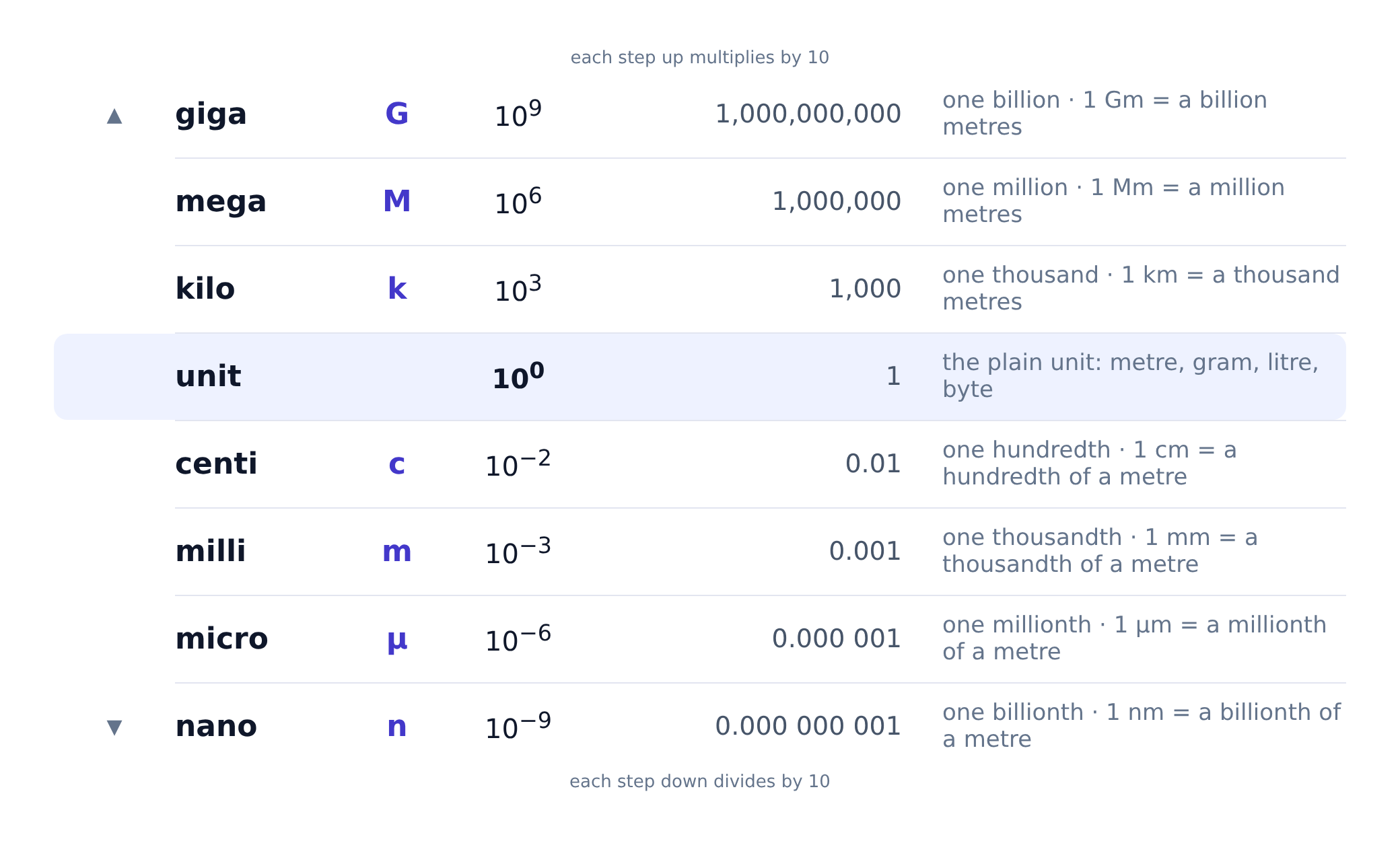
The same ladder as a list. Giga, G, 109, one billion. Mega, M, 106, one million. Kilo, k, 103, one thousand. The plain unit, 100, one. Centi, c, 10−2, one hundredth. Milli, m, 10−3, one thousandth. Micro, symbol µ, 10−6, one millionth. Nano, n, 10−9, one billionth.
Sita’s 25 gigabytes is 25 × 109 bytes. Her brother’s 250 milligrams is 250 × 10−3 grams, which is 0.25 grams. Same system in both directions: attach a name to a power of ten.
Idea 4: convert through the plain unit
To change from one prefixed unit to another, walk the ladder through the plain unit in two steps. First undo the starting prefix by multiplying, then apply the target prefix by dividing. Converting 4.2 kilometres to metres: kilo means 103, so multiply, 4.2 × 1,000 = 4,200 metres. Converting 750 metres to kilometres: divide by 1,000, so 750 ÷ 1,000 = 0.75 km.
When both units carry prefixes, count the steps between them. From kilometres to centimetres is five steps up the ladder (kilo to unit is three, unit to centi is two more), so multiply by 105: 2 km = 200,000 cm. The step count is the difference between the two exponents, and the direction tells you whether the number grows or shrinks.
Scientific notation writes any quantity as a number between 1 and 10 multiplied by a power of ten. Mount Everest stands 8,849 metres tall: that is 8.849 × 10³ m. A virus about 100 nanometres across measures 100 × 10−9 m, which tidies to 1 × 10⁻⁷ m. The form keeps huge and tiny numbers short, and it keeps the size visible at a glance, because the exponent carries the scale.
Worked example 1: reading a power of ten
Write 105 as an ordinary number.
Count the tens: the exponent 5 means five tens multiplied together: 10 × 10 × 10 × 10 × 10. Multiply step by step: 100, 1,000, 10,000, 100,000. Check with the shortcut: a 1 followed by five zeros is 100,000. Both routes agree, as they must.
Your turn A: write 10−3 as an ordinary decimal.
Check your attempt
Explanation: the negative exponent counts decimal places: 10−3 = 0.001, one thousandth. Dividing 1 by ten three times gives the same result: 1, 0.1, 0.01, 0.001.
Worked example 2: moving the decimal point
Calculate 6.4 × 10² and 9.1 ÷ 103.
Move the point by the exponent: multiplying by 102 slides the point two places right: 6.4 becomes 640. Dividing by 103 slides it three places left: 9.1 becomes 0.0091, filling the empty places with zeros. The digits never change their order; only their position changes.
Your turn B: calculate 0.35 × 10⁴.
Check your attempt
Explanation: four places right: 0.35 becomes 3.5, then 35, then 350, then 3,500. So 0.35 × 104 = 3,500.
Worked example 3: converting with one prefix
Convert 2.5 kilograms to grams, and 500 milligrams to grams.
Undo the prefix with its power of ten: kilo means 103 = 1,000, so 2.5 kg = 2.5 × 1,000 = 2,500 g. Milli means 10−3 = 0.001, so 1 mg = 0.001 g, and 500 mg = 500 × 0.001 = 0.5 g. Notice the second answer could also come from dividing by 1,000, because a gram holds a thousand milligrams.
Your turn C: convert 950 metres to kilometres.
Check your attempt
Explanation: a kilometre holds 1,000 metres, so divide: 950 ÷ 1,000 = 0.95 km. The point moved three places left, filling one gap with a zero.
Worked example 4: between two prefixes
Convert 3 kilometres to millimetres.
Count the ladder steps: kilo sits at 103 and milli at 10−3, six steps apart, so multiply by 106 = 1,000,000. Then 3 km = 3 × 1,000,000 = 3,000,000 mm. Check it through the plain unit: 3 km = 3,000 m, and 3,000 m = 3,000 × 1,000 mm = 3,000,000 mm. Same answer, as it must be.
Worked example 5: scientific notation
Write 25 gigabytes and 0.0004 metres in scientific notation.
Place the point after the first digit, then count the move: 25 GB = 25,000,000,000 bytes. Putting the point after the first digit gives 2.5, and the point moved ten places, so 2.5 × 1010 bytes. For 0.0004 m the point moves four places right to make 4, so the exponent is negative: 4 × 10⁻⁴ m. The number in front always stays between 1 and 10.
Independent practice
Answer on paper. Open each explanation only after your own attempt.
P1. Write 106 as an ordinary number.
Check your attempt
Explanation: six tens multiplied together, or a 1 with six zeros: 1,000,000, one million. This is the prefix mega.
P2. Write 10−2 as an ordinary decimal.
Check your attempt
Explanation: two decimal places: 0.01, one hundredth. This is the prefix centi.
P3. Calculate 5.2 × 10³.
Check your attempt
Explanation: the point moves three places right: 5.2 becomes 5,200.
P4. Calculate 83 ÷ 102.
Check your attempt
Explanation: the point moves two places left: 83 becomes 0.83.
P5. Convert 7 kilometres to metres.
Check your attempt
Explanation: kilo means 1,000, so 7 km = 7 × 1,000 = 7,000 m.
P6. Convert 1,350 metres to kilometres.
Check your attempt
Explanation: divide by 1,000: 1,350 ÷ 1,000 = 1.35 km. Kathmandu to a point 1.35 km away is a short walk, and saying 1.35 km is easier than saying 1,350 metres.
P7. Convert 500 milligrams to grams.
Check your attempt
Explanation: a gram holds 1,000 milligrams, so 500 mg = 500 ÷ 1,000 = 0.5 g, half a gram.
P8. Convert 3.75 kilograms to grams.
Check your attempt
Explanation: multiply by 1,000: 3.75 kg = 3,750 g.
P9. A phone plan offers 2 gigabytes of data. Using the metric meaning of giga, how many megabytes is that?
Check your attempt
Explanation: giga is 109 and mega is 106, three steps apart, so multiply by 103: 2 GB = 2,000 MB. (Computers sometimes use giga loosely for 1,024 × 1,024 × 1,024 bytes; the strict name for that is gibibyte. This lesson uses the metric meaning throughout.)
P10. Mount Everest is 8,849 metres tall. Write its height in scientific notation.
Check your attempt
Explanation: the point moves three places to sit after the 8: 8.849 × 10³ m.
P11. A virus is about 100 nanometres across. Write this in metres, in scientific notation.
Check your attempt
Explanation: nano is 10−9, so 100 nm = 100 × 10−9 m = 1 × 10⁻⁷ m, because 100 = 102 and 102 × 10−9 = 10−7.
P12. Which is larger, 5 × 10⁻² or 7 × 10⁻³?
Check your attempt
Explanation: write both out: 0.05 and 0.007. So 5 × 10⁻² is larger. With negative exponents, the smaller exponent gives the larger number, because fewer divisions by ten have happened.
Check, return and extend
Try these exit questions without looking back. If any feels shaky, reread the matching idea before tomorrow.
E1. What does the exponent in 104 count?
E2. What do the prefixes kilo and milli mean, as powers of ten?
E3. Convert 0.8 km to metres.
E4. Write 63,000 in scientific notation.
Check your answers
Explanation: E1: the number of tens multiplied together (and the number of zeros in the result). E2: kilo = 103 = 1,000; milli = 10−3 = 0.001, one thousandth. E3: 0.8 × 1,000 = 800 m. E4: 6.3 × 10⁴.
Return review. Later today, redo the starting check from memory. In two or three days, redo P3, P7 and P10 without opening the explanations. After about a week, find three real quantities at home, on a packet, a bill or a device, and write each one in two different prefix forms.
Extend beyond. Engineers prefer exponents in multiples of three, so 47,000 becomes 47 × 103 rather than 4.7 × 10⁴; this matches the ladder steps of kilo, mega and giga. Computers measure memory in powers of two with their own prefixes, kibi, mebi and gibi, where 1 gibibyte = 1,024 × 1,024 × 1,024 bytes. And when measurements are not exact, significant figures decide how many digits are worth writing. Each idea earns its own lesson later.
Sources and limits
The explanations, examples, diagram, interactive converter and questions are original. Powers of ten, the SI prefixes, their symbols and the spacing and capitalisation rules were checked against the BIPM SI Brochure. The byte is not an SI unit; it appears because storage sizes use the same metric prefixes.
This is not an official paper, teacher-endorsed course or complete chapter. Engineering notation, binary prefixes and significant figures need their own lessons. Spaced review is informed by the IES learning practice guide; the suggested timing is not an optimal schedule proven for every learner. This material has not been reviewed by a qualified NEB teacher.
Revision F04-R1 · Arithmetic checked exactly · 21 November 2026.